
Antimicrobial resistance (AMR) remains one of the greatest challenges to global public health. In the European Union, antibiotic-resistant infections are responsible for more than 35,000 deaths per year and healthcare costs exceeding €1.5 billion annually, according to the European Centre for Disease Prevention and Control (ECDC). Moreover, a report released by the World Health Organization (WHO) one month ago quantified that, between 2018 and 2023, antibiotic resistance increased by over 40% among the pathogen–antibiotic combinations monitored, with an average annual rise of between 5% and 15%.
In this context, the results of the European IMAGINE project, co-funded by the European Commission’s EU4Health programme, provide robust evidence that well-designed, multifaceted preventive interventions can significantly change clinical practices in long-term care facilities, reducing both the incidence of urinary infections and the unnecessary use of antibiotics in urinary tract infections.
Across European care homes, more than two million urinary infections occur each year, and between 30% and 80% of antibiotic treatments are unnecessary or inappropriate.
IMAGINE: Three years of research across eight European countries
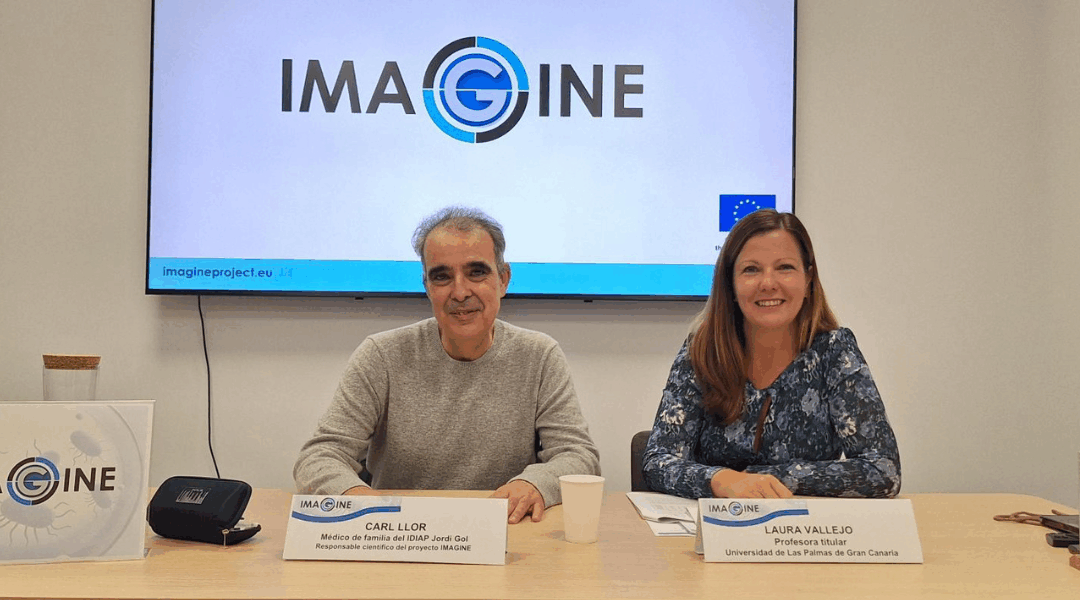
IMAGINE (Improving antibiotic use in long-term care facilities by infection prevention and control and antibiotic stewardship) presents its results after three years of research (2023–2025) in over 100 long-term care homes in Denmark, Greece, Hungary, Lithuania, Poland, Slovakia, Slovenia, and Spain. Scientifically coordinated by the Institut Català de la Salut (ICS), the project combined participatory action research (PAR) and clinical audits before and after intervention (using the APO methodology for antibiotic use analysis and IPC for preventive measures. Effectivity along with economic analysis were led by the University of Las Palmas de Gran Canaria (ULPGC). The project assessed the impact of a multifaceted intervention aimed at healthcare professionals in long-term care settings.
Results: 27% reduction in antibiotic-treated urinary infections
According to the final report, evidence-based results from data from the APO cycles, the incidence of antibiotic-treated UTIs decreased significantly in the overall sample (from 12.2% before the intervention to 8.9% afterwards). Additional findings include a reduction in unnecessary antibiotic use for urinary infections in residents without catheters (from 52.9% to 46.1%) and improved adherence to first-line therapeutic antibiotic choices in accordance with international clinical practice guidelines (from 23.7% to 21.6%).
By country, the most consistent improvements were observed in Lithuania and Slovakia, followed by Slovenia, Spain, and Poland, where the intervention’s impact was particularly notable. In Spain, the proportion of urinary infections treated with antibiotics fell from 26.6% to 13.3% (a 50% reduction), and inappropriate antibiotic use for uncomplicated UTIs declined from 60.2% to 46.2% (a 23.3% decrease).
Audits also showed improvements in 17 of 29 infection prevention and control indicators, including better use of clean aprons for each procedure and greater compliance with hand hygiene using disinfectants when handling urinary catheters—key measures for preventing urinary infections and achieving meaningful results.
In parallel, professional satisfaction and perceived quality of care improved across all participating countries, particularly in Greece and Denmark, where teams valued the programme’s participatory approach.
“We have confirmed that simple, well-structured, evidence-based interventions can produce measurable clinical change in a complex setting such as care homes for older adults,” explained Dr Carl Llor, family physician and researcher at ICS, and overall coordinator of the IMAGINE project. “The results confirm that combining audit, training, and communication enhances patient safety and optimises antibiotic use without requiring major investment”.
Many improved prevention indicators—such as the availability of disinfection instructions or easier access to hygiene materials—do not require large financial resources.
Economic evidence: €150 million in annual net savings across Europe
According to the economic analysis detailed in the report Roadmap for upscaling at EU level (Deliverable D5.4), implementing IMAGINE’s intervention across all 27 EU Member States would cost approximately €50 million, yielding gross savings exceeding €200 million per year and net annual savings of around €150 million.
Scaling up the intervention could prevent over 540,000 urinary infections annually in care homes at an average cost of €13.9 per resident. The countries with the highest projected economic benefit are Spain, Germany, France, and Italy, each saving more than €10 million per year. In Spain, estimated annual savings for the healthcare system could reach €30 million.
The evidence is clear: well-designed preventive interventions are cost-effective from both health and economic perspectives. Moreover, the benefits are not limited to the short term—a sustained reduction in urinary infections means fewer hospitalisations, reduced antibiotic consumption in the medium term, and lower bacterial resistance”, stressed Laura Vallejo Torres.
The analysis identified country-specific differences linked to baseline infection rates, hospitalisation costs, and implementation models (in-person or hybrid). Nonetheless, even under conservative scenarios, most Member States showed a positive return on investment.
A reference framework for European health policy
IMAGINE researchers believe that the methodology could be integrated into national infection control and antibiotic stewardship strategies. The project recommends that any EU-wide scale-up be coordinated by a European public health body, prioritising countries with higher antimicrobial resistance rates and greater urinary infection burdens in care homes.
The long-term care sector has traditionally been overlooked in antimicrobial resistance policies,” noted Dr Carl Llor. “IMAGINE shows that effective intervention is possible, using a reproducible, low-cost methodology without the need for complex regulatory structures. The key lies in empowering, motivating, and supporting professionals.
The IMAGINE project aligns with the European “One Health” strategy against antimicrobial resistance and builds upon previous initiatives such as HAPPY PATIENT, which focused on nursing homes, primary care, out-of-hours services and community pharmacies. Both share the objective of reducing inappropriate antibiotic use and fostering a culture of responsible prescribing among healthcare professionals.
The study design combined pre- and post-intervention clinical audits, face-to-face and online training sessions, comparative data analysis, and group feedback meetings. The intervention was implemented in more than 100 care homes, involving over 400 nursing, medical, and care professionals. CAP (WP2) was responsible for the infection prevention audit and for developing the intervention material through the Participatory Action Research (PAR) process, while RUPO (WP3) led the antibiotic audits and the analysis of their results using the Audit Project Odense methodology (APO).
The IMAGINE approach is innovative because it does not impose external protocols; it promotes change from within the care teams themselves,” explained Dr Carl Llor. “Clinical audit and participatory multicentre intervention have proven effective tools to reduce unnecessary prescribing and encourage more prudent antibiotic use in settings where medical practice is often routine or protocol-based.
The consortium recommends extending this model within the European ‘One Health’ strategy on antimicrobial resistance, prioritising long-term care settings. IMAGINE demonstrates that better care is not more expensive—it is smarter: investing in prevention and responsible antibiotic use reduces both patient suffering and healthcare costs.