
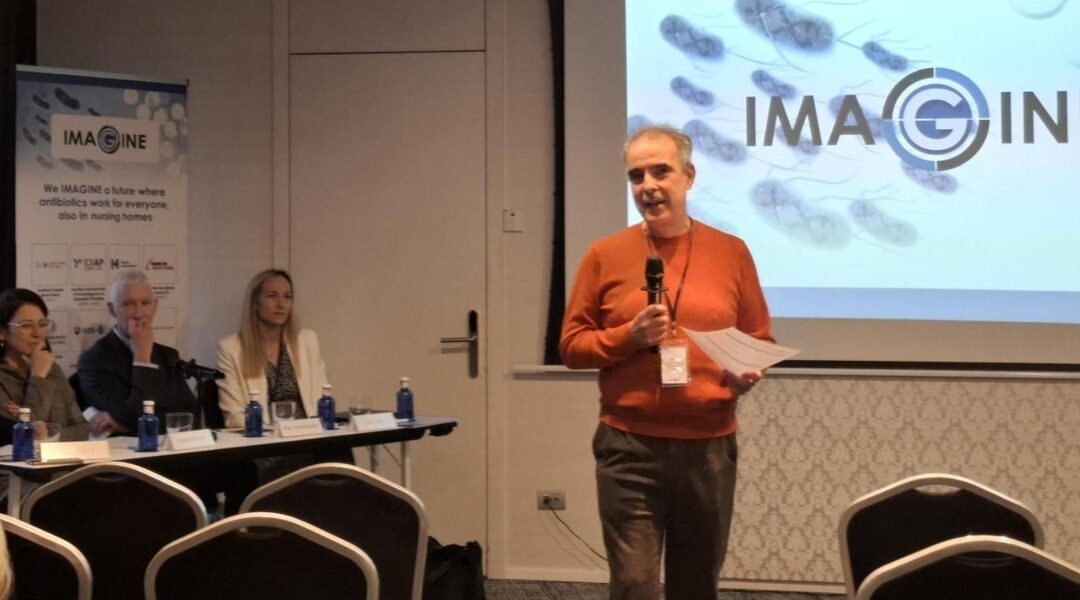
Today, the Final Conference of the IMAGINE Project was held in Barcelona, bringing together consortium members and representatives from the participating countries, as well as European officials, to share the results achieved after three years of analysis.
The opening session
The opening session included Carl Llor, Project Coordinator, Institut Català de la Salut (ICS), Institut d’Investigació en Atenció Primaria Jordi Gol (IDIAP JGol); Julia Langer, Policy Officer of DG Health & Food Safety of the European Commission; Marc Vandenbroeck, Project Officer of HaDEA, European Commission; Elisabet Descals Singla, Primary Care Manager at ICS; and Josep Basora Gallisà, Manager at IDIAP JGol.
After Carl Llor’s welcome, Julia Langer briefly explained the initiatives the European Union is undertaking regarding antimicrobial resistance (AMR), which she considers a real public health problem requiring urgent reinforcement of measures for responsible administration, protection, prevention, and control. Langer provided an overview of the EU JAMRAI strategy and the different funding instruments currently in use, such as Health Emergency Preparedness and the Preventive, Study, and Response fund, with over €10 billion and €451 billion respectively, as well as Horizon Europe, the EU’s main research program. Specifically, the EU’s objectives are to reduce total human antibiotic consumption by 20% and, simultaneously, reduce total EU sales of antimicrobials for farmed animals and aquaculture by 5% by 2030.
Marc Vandenbroeck then reviewed the EU4Health program, an Annual World Health Programme designed to follow up on European Commission policy decisions, implement them, and fund projects like IMAGINE. He encouraged the consortium to continue working on the implementation of joint actions, taking advantage of the Commission’s interest in reducing antimicrobial resistance.
The opening session also included Elisabet Descals and Josep Basora, who thanked the IMAGINE Project for its work in combating antimicrobial resistance and encouraged continued efforts in this essential field.
IMAGINE Project results
Next, Carl Llor, as Project Coordinator, gave a brief presentation explaining the motivations behind IMAGINE, which arose from observing that measures to combat antimicrobial resistance in Europe were very low, especially in southern countries, and that existing efforts did not seem sufficient. Therefore, the project decided to focus on nursing homes and urinary tract infections (UTIs), which are often associated with antibiotic use, although antibiotics are not always necessary, and resistance can develop due to repeated use. Llor highlighted the simplicity of the analysis conducted, the engagement and commitment of participants, and the adaptability of interventions to the realities of different countries.
Within the IMAGINE Project, the work packages also presented the methodology used, such as APO, through which IMAGINE conducted two audits with a simple, paper-based, voluntary registry that generated strong engagement among healthcare professionals in more than 100 participating nursing homes. Additionally, the IPC methodology, developed collaboratively with participants through the PAR process, was presented. This resulted in 29 items to be recorded, also on paper to facilitate participant work—a co-created process by IMAGINE and nursing homes that helped focus on the measures necessary to monitor and record for improvement actions.
These actions, carried out by the IMAGINE Project and officially presented at the press conference on November 18th, showed significant reductions: nearly 60% of IPC measures were improved, unnecessary antibiotic prescriptions were reduced by 13%, and the incidence of antibiotic-treated UTIs decreased by 27%.
Regarding cost-effectiveness, IMAGINE interventions were shown to likely generate savings for health and social care systems in most of the eight participating countries. Moreover, when considering potential EU-level implementation by scaling the results, projected savings could reach €150 million annually, with a return of €4 saved for every €1 invested.
Finally, the rest of the day included participation from representatives of the participating countries, who presented local results as well as areas for improvement, previously discussed in the internal face-to-face meeting the day before. All participants expressed their gratitude for the opportunity to be involved in the IMAGINE Project and for the level of satisfaction achieved through its implementation.