
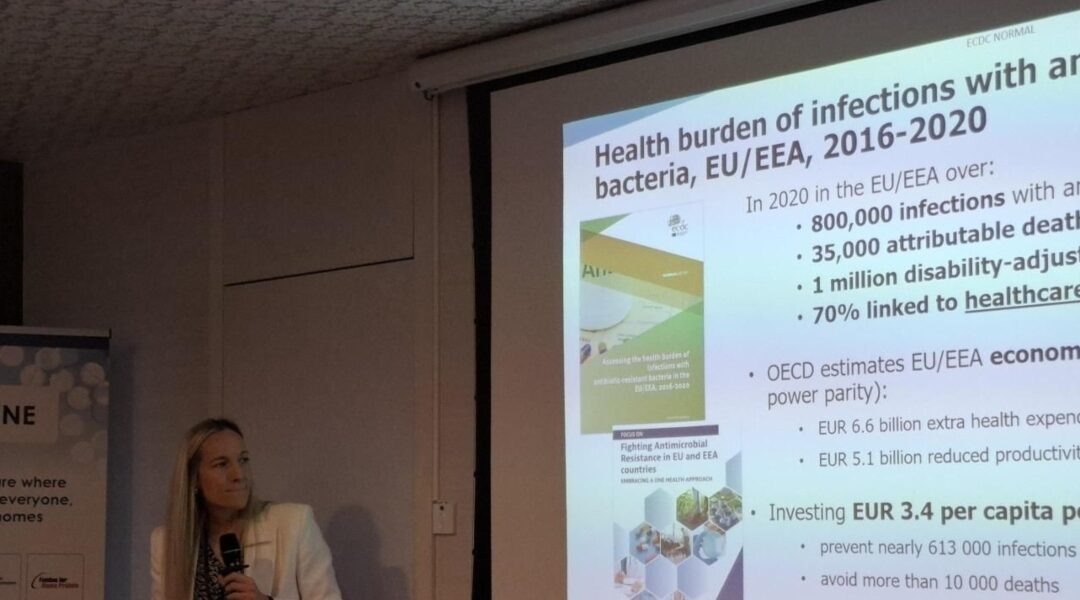
The European Commission reaffirms antimicrobial resistance (AMR) as a public health priority and presents regulatory, epidemiological and funding advances within the One Health approach during the final meeting of the IMAGINE Project, held in Barcelona on 12th December 2025, by Julia Langer, Policy Officer at the Directorate-General for Health and Food Safety (DG SANTE).
During her intervention, Langer reviewed during the final conference more than two decades of European action and recalled the evolution of the EU policy framework, from the 2001 Council Recommendation on the prudent use of antimicrobial agents in human medicine, to the 2009 Council Recommendation on patient safety, including the prevention and control of healthcare-associated infections, which resulted in two implementation reports and supported a joint action on patient safety through the EU programme.
Among the key milestones highlighted by Langer were the Commission Action Plan (2011–2016), the 2017 One Health Action Plan, the EU guidelines on the prudent use of antimicrobials in human health, and the 2023 Council Recommendation to step up action against AMR through a comprehensive approach.
Impact of AMR in the EU
Langer also underlined the scale of the health and economic impact of infections caused by antibiotic-resistant bacteria in the European Union and the European Economic Area. In 2020 alone, more than 800,000 infections were estimated, with 35,000 attributable deaths and around one million disability-adjusted life years (DALYs) lost, with 70% of cases linked to healthcare-associated infections. The total estimated economic cost amounted to €11.7 billion, combining additional healthcare expenditure and productivity losses.
In this context, the European Commission stressed that investing €3.4 per capita per year in a mixed policy package could prevent nearly 613,000 infections, avoid more than 10,000 deaths, save over €2.5 billion in health expenditure and yield approximately €2.3 billion in productivity gains. These figures reinforce the need to intensify infection prevention and control measures, as well as the responsible use of antimicrobials.
EU objectives
Key areas of action defined by the EU include strengthening national AMR action plans, improving surveillance of antimicrobial consumption and resistance, reinforcing infection prevention and control, promoting prudent prescribing, enhancing professional training and raising public awareness. The importance of boosting research, innovation and access to new antimicrobials, as well as strengthening international cooperation and global action, was also emphasised.
The European Commission also presented the latest data available at EU level, released on the occasion of the European Antibiotic Awareness Day on 18th November 2025, together with progress towards the EU’s AMR and antimicrobial consumption targets for 2030. However, the figures reveal an uneven and still insufficient level of achievement. Of the indicators monitored, five are currently not being met and it remains uncertain whether they will be achieved within the established timeframe. In particular, the indicator related to third-generation cephalosporin-resistant Escherichia coli shows a marked deviation from the target, while several other indicators have shown little to no improvement compared to baseline levels. To date, only one of the targets has already been achieved. These objectives, taking into account that at least 65% of total antibiotic consumption in humans should belong to the ‘Access’ group of antibiotics, include a 20% reduction in total antibiotic consumption, a 15% reduction in the total incidence of bloodstream infections, a 10% reduction in bloodstream infections caused by third-generation cephalosporin-resistant Escherichia coli, and a 5% reduction in bloodstream infections caused by carbapenem-resistant Klebsiella pneumoniae.
In terms of funding, Langer highlighted European support for AMR-related projects such as the EU JAMRAI 2 Joint Action, endowed with €50 million from the EU4Health programme, which includes, among other areas, work packages on infection prevention and control (IPC) in humans, animals and the environment, as well as behavioural change strategies. Looking ahead, the proposal for the new Multiannual Financial Framework 2028–2034 foresees significant investments in health, research and innovation, resilience and preparedness for health emergencies, all of which are closely linked to the fight against AMR.
Langer concluded the conference with a clear message: antimicrobial resistance remains a growing threat to public health in Europe and requires a sustained, coordinated and data-driven response, in line with the One Health approach that integrates human, animal and environmental health.